Web module to create email signatures Universidad de Piura
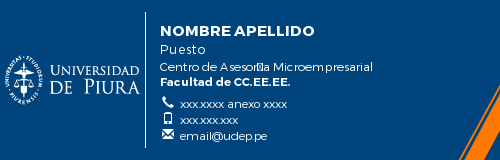
To personalize your email signature, enter the required information in the required fields. Please note that there is a limit on the number of characters. Once you are done, click the “create signature” button. This will automatically download a file in png format. Save it to your PC desktop and follow the instructions indicated in the pdf document.
Este modo permite a las personas con epilepsia utilizar el sitio web de forma segura al eliminar el riesgo de convulsiones que resultan de las animaciones intermitentes o parpadeantes y las combinaciones de colores arriesgadas.
Modo para personas con discapacidad visual
Mejora las imágenes del sitio web.
Este modo ajusta el sitio web para la comodidad de los usuarios con discapacidades visuales, como visión degradada, visión de túnel, cataratas, glaucoma y otras.
Modo de discapacidad cognitiva
Ayuda a concentrarse en contenido específico.
Este modo brinda diferentes opciones de asistencia para ayudar a los usuarios con deficiencias cognitivas, como dislexia, autismo, CVA y otras, a concentrarse más fácilmente en los elementos esenciales del sitio web.
Modo compatible con TDAH
Reduce las distracciones y mejora el enfoque.
Este modo ayuda a los usuarios con TDAH y trastornos del desarrollo neurológico a leer, navegar y concentrarse en los elementos principales del sitio web con mayor facilidad, al tiempo que reduce significativamente las distracciones.
Modo de ceguera
Permite usar el sitio con su lector de pantalla
Este modo configura el sitio web para que sea compatible con lectores de pantalla como JAWS, NVDA, VoiceOver y TalkBack. Un lector de pantalla es un software para usuarios ciegos que se instala en una computadora y un teléfono inteligente, y los sitios web deben ser compatibles con él.
Diccionario en línea
Experiencia legible
Escalado de contenido
Por defecto
Lupa de texto
Fuente legible
Apto para dislexia
Destacar títulos
Destacar enlaces
Tamaño de fuente
Por defecto
Altura de la línea
Por defecto
Espaciado de letras
Por defecto
Alineado a la izquierda
Centro alineado
Alineado a la derecha
Experiencia visualmente agradable
Contraste oscuro
Contraste de luz
Monocromo
Alto contraste
Alta saturación
Baja saturación
Ajustar colores de texto
Ajustar los colores del título
Ajustar los colores de fondo
Orientación Fácil
Silenciar sonidos
Ocultar imágenes
Teclado virtual
Guía de lectura
Detener animaciones
Máscara de lectura
Resaltar pasar el cursor
Resalte el enfoque
Gran cursor oscuro
Cursor de luz grande
Texto a voz
Teclas de navegación
Accessibility statement
www.udep.edu.pe
March 16, 2026
Compliance status
We firmly believe that the Internet should be available and accessible to everyone, and we are committed to providing a website that is accessible to as many people as possible, regardless of their circumstances and abilities.
To comply, we aim to adhere as closely as possible to the World Wide Web Consortium (W3C) Web Content Accessibility Guidelines 2.1 (WCAG 2.1) at level AA. These guidelines explain how to make web content accessible to people with a wide range of disabilities. Complying with these guidelines helps us ensure that the website is accessible to all people: blind people, people with motor, visual, cognitive impairments, etc.
This website uses various technologies to make it as accessible as possible at all times. We use an accessibility interface that allows people with specific disabilities to adjust the UI (user interface) of the website and design it according to their personal needs.
Additionally, the website uses an AI-based application that runs in the background and constantly optimizes its accessibility level. This application corrects the HTML code of the website, adapts its functionality and behavior to screen readers used by blind users and keyboard functions used by people with motor disabilities.
If you have detected any errors or have ideas to improve it, we will be happy to receive them. You can contact the website operators through the following email jose.rodriguez.co@udep.edu.pe
Screen reader and keyboard navigation
Our website applies the ARIA (Accessible Rich Internet Applications) attribute technique, along with various behavioral changes, to ensure that blind users who visit us with screen readers can read, understand and enjoy the functions of the website. As soon as a user with a screen reader enters your website, they are immediately prompted to enter their screen reader profile so they can navigate and use your website effectively. Here's how our website covers some of the most important requirements for screen readers, along with console screenshots of code examples:
Optimization for screen readers: We run a background process that learns website components from top to bottom, ensuring continuous compliance even when the website is updated. In this process, we provide screen readers with meaningful data using the ARIA attribute set. For example, we provide precise labels for forms, descriptions of actionable icons (social media icons, search icons, cart icons, etc.), guidance for validation of form inputs, functions of elements such as buttons, menus, Modal dialogs (pop-ups) and others. Additionally, the background process scans all images on the website and provides an accurate and meaningful description based on object recognition as an ALT (alternative text) tag for images that are not described. It will also extract the texts that are embedded in the image, using OCR (optical character recognition) technology. To activate screen reader settings at any time, users simply press the Alt+1 keyboard combination. Screen reader users also receive automatic prompts to activate screen reader mode as soon as they enter the website.
These settings are supported by all common screen readers, including JAWS and NVDA.
Keyboard navigation optimization: The background process also adjusts the HTML of the website and adds various behaviors using JavaScript code so that the website can be operated with the keyboard. This includes the ability to navigate the website with the Tab and Shift+Tab keys, operate dropdowns with the arrow keys, close them with Esc, activate buttons and links with the Enter key, navigate between radio elements and checkboxes with arrows on the keyboard, and fill them with the space bar or the Enter key. In addition, keyboard users will find quick navigation and content skip menus, available at any time by pressing Alt+1, or as the first elements of the site when browsing with the keyboard. The background process also handles triggered popups by moving keyboard focus toward them as soon as they appear, and not allowing focus to move away from them.
Users can also use shortcuts such as "M" (menus), "H" (headers), "F" (forms), "B" (buttons), and "G" (graphics) to jump to specific elements.
Disability profiles on our website
Epilepsy Safe Mode: This profile allows people with epilepsy to use the website safely, eliminating the risk of seizures caused by flashing or flashing animations and risky color combinations.
Mode for the visually impaired: This mode adjusts the website for the comfort of users with visual impairments such as Vision Deterioration, Tunnel Vision, Cataracts, Glaucoma and others.
Cognitive disability mode: This mode offers different assistance options to help users with cognitive impairments such as dyslexia, autism, CVA and others, to focus more easily on the essential elements of the website.
ADHD Friendly Mode: This mode helps users with ADHD and neurodevelopmental disorders read, navigate, and focus on the main elements of the website more easily, while significantly reducing distractions.
Blind Mode: This mode configures the website to be compatible with screen readers such as JAWS, NVDA, VoiceOver, and TalkBack. A screen reader is software for blind users that is installed on computers and smartphones, and websites must be compatible with it.
Keyboard navigation profile (motor disabled): This profile allows people with motor disabilities to operate the website using the Tab, Shift+Tab and Enter keys. Users can also use shortcuts such as "M" (menus), "H" (headers), "F" (forms), "B" (buttons), and "G" (graphics) to jump to specific elements.
Additional UI, Layout, and Readability Tweaks
Font settings – Users can increase and decrease its size, change its family (type), adjust spacing, alignment, line height, etc.
Color settings – Users can select various color contrast profiles, such as light, dark, inverted, and monochrome. Additionally, users can change the color schemes of titles, texts and backgrounds, with over 7 different coloring options.
Animations – Epileptic users can stop all running animations with the push of a button. Interface-controlled animations include videos, GIFs, and CSS flashing transitions.
Content Highlighting – Users can choose to highlight important elements such as links and titles. You can also choose to highlight only focused or mouseover elements.
Audio Mute – Users with hearing devices may experience headaches or other problems due to automatic audio playback. This option allows you to silence the entire website instantly.
Cognitive disorders – We use a search engine linked to Wikipedia and Wiktionary, allowing people with cognitive disorders to decipher the meaning of phrases, initials, slang, and more.
Additional functions - We offer users the option to change the color and size of the cursor, use a print mode, activate a virtual keyboard, and many other features.
Browser support and supporting technologies
Our goal is to offer compatibility with the greatest possible number of browsers and supporting technologies, so that our users can choose the tools that best suit their needs, with the fewest possible limitations. Therefore, we have worked very hard to be compatible with major systems, which account for more than 95% of user market share, including Google Chrome, Mozilla Firefox, Apple Safari, Opera and Microsoft Edge, JAWS and NVDA (screen readers ), for both Windows and MAC users.
Notes, comments and opinions
Although we make every effort to enable anyone to adapt the website to their needs, there may still be pages or sections that are not fully accessible, are in the process of becoming so, or lack an appropriate technological solution to make them accessible. Still, we are continually improving our accessibility, adding, updating and improving its options and features, and developing and adopting new technologies. All this in order to achieve the optimal level of accessibility, following technological advances. If you need help, contact jose.rodriguez.co@udep.edu.pe



 EN
EN  ES
ES