CurriculumCurriculumSumillasMethodology

Curriculum

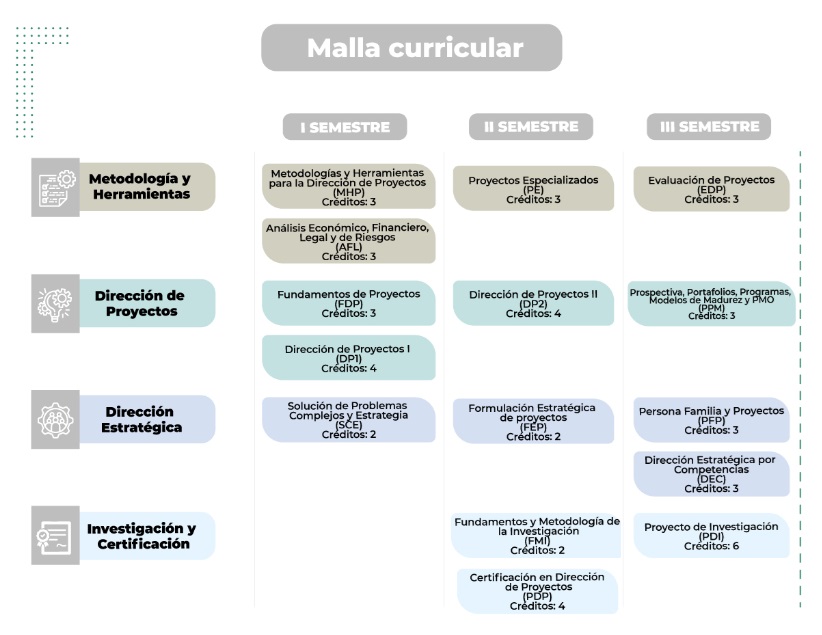
The Master's program in Project Management has 48 credits:

  • 5 general credits.
  • 43 specialty credits.

Curriculum

CYCLE I
  • Methodologies and Tools for Project Management
  • Economic, Financial, Legal and Risk Analysis
  • Project Fundamentals
  • Project Management I
  • Complex Problem Solving and Strategy


CYCLE II
  • Specialized Projects
  • Project Management II
  • Strategic Project Formulation
  • Project Management Certification
  • Fundamentals and Methodology of Research


CYCLE III
  • Project Evaluation
  • Foresight, Portfolios, Programs, Maturity Models and PMO
  • Strategic Management by Competencies
  • Person, Family and Projects
  • Investigation project

Course Summary

First Semester (15 credits)

Methodologies and tools for project management (3 credits)

The subject of Methodologies and Tools for Project Management is theoretical and practical in nature. Its main objective is to evaluate, select, and implement methodological tools within the body of knowledge of general project theory, as well as to apply methodologies and tools to design and manage projects that satisfy a need, solve a problem, or take advantage of a real market opportunity.

The summary of the contents is based on: Simulation, Flowchart, Ishikawa Diagram, Data Collection Sheet, Histogram, Pareto Chart, Control Charts, Affinity Diagram, Relationship Diagram, Tree Diagram, Matrix Diagram, Prioritization Diagram, Arrow Diagram, Decision Process Diagram, Critical Path Method, Earn Schedule, Fast-tracking and Crashing, Earn Value, Logical Method, Agile Methods and Microsoft Project.

Economic, financial, legal and risk analysis (3 credits)

The Economic, Financial, Legal, and Risk Analysis course is theoretical and practical in nature. Its main objective is to apply methods and tools for project evaluation in the financial, economic, legal, and risk aspects, as well as to manage projects that meet specific needs while considering economic and legal factors.

The summary of the content focuses on analyzing economic and financial aspects, identifying necessary resources, and allocating them appropriately to activities. It also involves determining the expected benefits for the company and understanding the relevant laws, regulations, legal restrictions, risks, and contractual relationships between clients and suppliers.

Project Fundamentals (3 credits)

The Fundamentals of Project Management course is theoretical and practical in nature. Its main objective is for students to be able to apply knowledge, skills, tools, and techniques to the processes of project management, administration, and direction in order to meet project requirements.

The summary of the contents is based on the project life cycle, ethical and professional responsibility in projects, and the historical context regarding the momentous events that led to the formation of Project Management as a profession, the megaprojects that were developed throughout history, and the main practices, principles, and processes that project managers used to carry them out.

Project Management I (4 credits)

The Project Management I course is theoretical and practical in nature. Its main objective is to define the scope boundaries, manage the project, and control changes. It also aims to ensure that participants learn and apply the knowledge and skills necessary for project execution.

The summary of contents is based on the initiation process (project integration management), planning process (management of project scope, resources, schedule and cost), execution process, monitoring and control.

Complex problem solving and strategy (2 credits)

The subject of Complex Problem Solving and Strategy is theoretical and practical in nature. Its main objective is to align project goals and objectives with its program and portfolio, and these with the organization's strategy, as well as to design strategies and/or propose changes to the plan that allow for the resolution of complex problems that may arise throughout the project life cycle.

The summary of the contents is based on the introduction to decision-making for solving complex problems, the process of developing strategic planning, tools for developing the strategic plan, operations strategy and types of processes.


Second Semester (11 credits)

Specialized Projects (3 credits)

The subject of Specialized Projects is of a theoretical-practical nature.

Its main objective is to determine and analyze trends that exist in different markets and industries, applying the methodologies and tools learned in the various types of projects.

The summary of the contents is based on the methodologies and tools of quality management in specialized projects, standardization, ISO 9001:2015, 7 principles of quality management, process map and 5s methodology.

Project management II (4 credits)

The Project Management II course is theoretical and practical in nature. Its main objective is to design and manage a project that satisfies a need, solves a problem, or takes advantage of a real market opportunity, according to the areas of knowledge and the project life cycle.

The summary of contents is based on planning processes (quality management, communications, procurement, stakeholders and project risk), execution processes, monitoring and control (quality management, communications, procurement, stakeholders and project risks), closing processes and agile processes.

Strategic project formulation (2 credits)

The subject of Strategic Project Formulation is of a theoretical-practical nature.

Its main objective is to master the strategic and environmental concepts of the organization, as well as the skills required to strategically align solutions to problems (strategic initiatives/projects) that affect today's society, using knowledge related to the concepts and methodology of Strategic Project Management.

The summary of contents is based on the logical framework, strategic project management and elements of competence of the international scheme IPMA ICB 4.0, concept engineering study and the delivery methods and typology of contracts.

Project Management Certification (4 credits)

The Project Management Certification course is theoretical and practical in nature. Its main objective is to strengthen participants' solid knowledge of project management, according to the international standard PMBOK (Project Management Body of Knowledge), Seventh Edition, promoted by the PMI (Project Management Institute) internationally. It also prepares participants to successfully pass the PMP or CAPM certification exam. Furthermore, it seeks to provide an in-depth understanding of Humanistic Project Management.
And prepare the participant for the IPMA Level D certification exam.

The content summary is based on project management principles (governance, project team, stakeholders, leadership, adaptability and resilience, holistic thinking, adaptation, quality, complexity, risk, change management, and value), project performance domains (stakeholders, project team, development approach and life cycle, planning, project work, delivery, measurement, and uncertainty), and the PMP certification process. It also covers IPMA competencies and the IPMA Level D certification process.

Fundamentals and Research Methodology (2 credits)

The subject of Fundamentals and Methodology of Research is theoretical and practical in nature. Its main objective is to understand the epistemic paradigms of research that predominate in the sciences, as well as to recognize when information is needed during each stage of the project and to have the ability to locate, evaluate, use, and communicate such information ethically in all official project documents.

The summary of the contents is based on the principles of science and research idea, the feasibility and structure of the research project, the theoretical framework, the foundation and the methodology of the research.


Third Semester (22 credits)

Project Evaluation (3 credits)

The Project Evaluation course is theoretical and practical in nature. Its main objective is to enhance the director's ability to successfully design and manage the evaluation of a project or program, especially (though not exclusively) in the field of rural development and development cooperation.

The summary of contents is based on the introduction to planning (planning and evaluation, introduction to development evaluation, expansion and use of evaluation), evaluation design (design of a monitoring and evaluation system, models, quantitative and qualitative tools), evaluation participation (participatory evaluation, ethnographic concepts for evaluation, workshops in diverse cultural contexts, the art of engaging participants) and professional evaluation practice (network theory for evaluation: Governance in development, use of data visualization and new technologies in evaluation design).

Foresight, Portfolios, Programs, Maturity Models and PMO (3 credits)

The course on Foresight, Portfolios, Programs, Maturity Models, and PMO is theoretical and practical in nature. Its main objective is for the director to design and manage a project that satisfies a need, solves a problem, or takes advantage of a real market opportunity, according to the areas of knowledge and the project life cycle.

The summary of the contents is based on the context of project management (projects, programs, portfolios), implementation of strategy through projects (governance: organizational concepts and interrelationships. Strategic considerations for the study and selection of projects), prioritization and strategic decision-making (Methods for evaluating strategic projects for their proper prioritization within a program or portfolio), organizational maturity models in Project Management (Impact of Project Management on the Organization; Concept of Organizational Maturity; Current Models (OCB, OPM3, People CMM, P3M3); Implementation Methods; Benefits for the organization) and standards and excellence in Project Management (ISO 21500:2012; ISO 21504:2015; PEB-IPMA; Global Agreement Project Performance Standards (GAPPS)).

Strategic Skills Management (3 credits)

The Strategic Management by Competencies course is theoretical and practical in nature. Its main objective is to identify the appropriate competencies you should use when leading your project team, in order to achieve optimal project results while simultaneously meeting the organization's objectives and needs.

The summary of the contents is based on the management of human talent, the management of international project teams, the development of individual, team and organizational competence, the project team life cycle, emotional intelligence, leadership styles in projects, the performance and recognition system in projects and responsibility, professional ethics and sustainability in project management.

Person, Family and Projects (3 credits)

The subject of Person, Family and Projects is theoretical-practical in nature. Its main objective is to understand the concepts of philosophical anthropology and their application to the human field in general and to business practice in particular.

The course content summary is based on fundamental notions of professional ethics: the human person and the importance of understanding them; organizational governance and leadership; the logic of human action in project formulation and implementation, and decision-making; projects and family as spheres of human development; the family as the nucleus of human and social development, including current trends among Peruvian families; agents of work-life balance and the workshop "Reconciling Work and Family Life"; and the family perspective and the gender equity perspective in companies.

Research Project (6 credits)

The Research Project course is theoretical and practical in nature. Its main objective is to obtain high-quality information and know how to use it. Students will learn to apply the style guidelines established by the faculty to a thesis or research paper, construct a thesis or research paper plan, and understand the basic structure for developing a thesis or research paper.

The summary of contents is based on Information Literacy. Style Guidelines. Contextual Framework. Theoretical Framework. Methodology. Results. Analysis and Discussion of Results. Conclusions.

Methodology

The modality blended is developed through:

  • In-person classes
    Lectures, colloquiums, conferences, discussion of cases, teamwork, theoretical and practical workshops, etc.
  • Project realization
    Application, research, bibliographic review and database use.
  • Teacher advice
    Corresponding to theoretical and practical aspects related to each of the subjects.
  • Technical visits
    Guided visits to national and international megaprojects.
  • Seminars
    Preparation for international certifications. It will be complemented with activities to be developed in the non-face-to-face modality.
  • Online link sessions
    With teachers and subject specialists.
  • Personal study
    Based on different sources of information.
  • Discussion forums
    Through an exclusive blog for the master's program.

To facilitate student learning, we propose a set of strategies, procedures and organized actions, which are consciously and reflectively planned in the didactic programming and seek to reach the objectives. In this sense, the methodology acts as a hinge between the objectives, competencies and evaluation.

The teaching methodologies that we propose include those that will serve to carry out an initial evaluation of knowledge, to those that seek to present the contents, reinforce and expand the lesson and, of course, the evaluation. Therefore, the methodology will include, in addition to mind maps, brainstorming, role-playing games, case studies, debates and portfolios, the following:

  • Flipped Classroom
  • Project Based Learning
  • Cooperative learning
  • Gamification
  • Problem-based learning
  • Design Thinking
  • Design Thinking (DT) – or “Design Thinking”
  • Thinking Based Learning
  • Competency Based Learning