Curriculum
The master's program in Structural Integrity has 54 credits:
- 2.5 general credits
- 51.5 specific and specialty credits
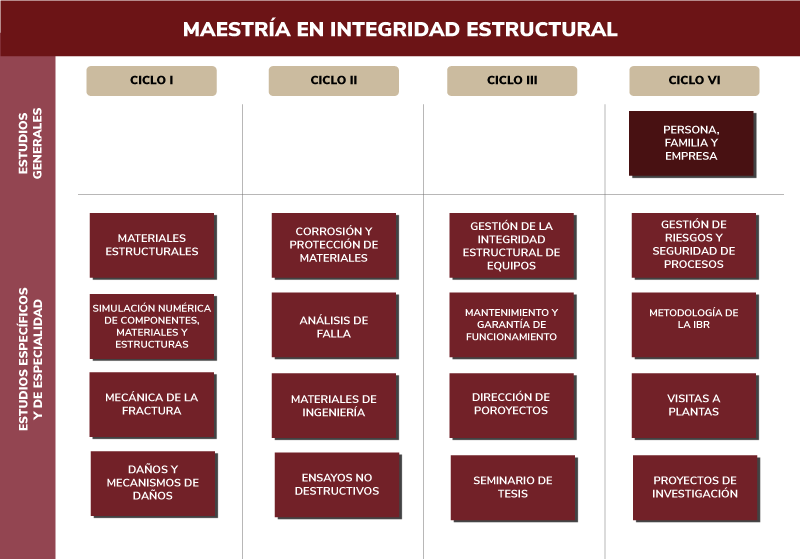
Detailed Study Plan
| Cycle | courses |
| Cycle I | • Structural Materials • Numerical simulation of components, materials and structures • Fracture mechanics • Damage and damage mechanisms |
| Cycle II | • Corrosion and protection of metals • Failure Analysis • Materials in Engineering • Non destructive essays |
| Cycle III | • Management of structural integrity of equipment • Maintenance and guarantee of operation • Project management • Thesis seminar |
| Cycle IV | • Person, family and company • Risk management and process safety • IBR Methodology • Visits to plants • Investigation project |
Sumillas
First semester
The Structural Materials course, of a theoretical-practical nature, provides the teacher with conceptual and practical tools of the different methodologies of modern structural analysis, increasing their knowledge and understanding of the mechanical properties that define them as structural materials, allowing them to:
- Use the most appropriate ones for the design of an asset or a process
- Find solutions to the problems of the main ferrous and non-ferrous materials used in industrial structures and equipment whose results allow them to be designed with a reasonable degree for service loads.
The eminently practical subject is aimed at training and updating teachers by offering them the tools to understand both physical phenomena and the necessary foundation of the necessary numerical techniques such as the Finite Element Method, Mesh Generation, analysis of stresses and deformations, modal analysis and associated knowledge of immediate application for carrying out computational simulations, using CAE software such as Ansys in different complex and real engineering systems. This knowledge is essential in the development of projects.
This subject, of a theoretical-practical nature, explains the fundamentals to understand the relationships between the size and shape of a crack and the forces or loads that lead to the fracture of a component of defined shape and dimensions, in service. The different fracture analysis methodologies are explained, with special emphasis on linear-elastic fracture. The concepts of fracture mechanics are applied to the propagation of cracks according to the different failure mechanisms, guiding towards the concept of structural integrity.
This subject of a theoretical-practical nature is oriented so that the teacher can learn about the behavior of materials under the different stresses that induce mechanical, microstructural damage, due to interaction with the environment, etc. Special emphasis is placed on fatigue damage, creep, stress corrosion, wear, erosion, high and low temperature damage, among others.
Second semester
The Corrosion and Protection of Metals Course, of a theoretical-experimental nature, aims to develop the mechanisms that govern corrosion phenomena through laws, theories, and laboratory tests. Likewise, it will teach modern techniques for protecting metal surfaces exposed to corrosive media in industries and the environment, taking as a knowledge base the thermodynamic, electrochemical and surface chemistry fundamentals to apply preventive actions.
This subject explains the various methodologies of Analysis of Potential Failure Modes and Effects (FMEA) and Root Cause Analysis (RCA), aimed at eliminating or minimizing the risks associated with component failures. Various representative cases of the most frequent failure mechanisms will be studied and some examples of simulation and failure modeling will be carried out.
The physical metallurgy of the main industrial alloys is explained: balance diagrams, thermal treatments to understand their response to service conditions and process variables that may affect their performance. Topics on the behavior of ceramics, polymers and composites of greater industrial use are also given.
The Non-Destructive Testing subject will provide the teacher with professional training in the different inspection methods that are applied to different industries and in diverse situations, to guarantee the safe and reliable operation of the components of an industrial plant. This is supported in the domain of techniques such as ultrasound, thermography, visual inspection, penetrating liquids, magnetic particles, etc.
Third semester
The subject has the objective of managing the reliability, technical integrity and operability of assets to maximize their availability and performance, guarantee regulatory compliance and protect the environment, personnel and the community.
The course provides concepts, techniques and practices adopted in maintenance management and asset management (ISO 55000) such as strategic planning, establishing its link with risk management. The aspects to be developed to implement them in an industrial plant are explained, including the tree structure (taxonomy according to ISO 14224), coding, criticality, Indicators such as Reliability, Maintainability, Availability and the Overall Effectiveness of the equipment (OEE). Concepts linked to costs are also taught, fundamentally to the cost of the life cycle of assets and management optimization methodologies, specifically, Reliability Centered Maintenance (RCM).
This subject provides students with the fundamentals of the project cycle, directing them towards project management, through the use of Project Management tools (PMBOK® Guide) that covers the nine areas of knowledge (integration, scope, time, costs, quality, human resources, communication, risk and procurement) and the respective processes (initiation, planning, execution, control and closure). The topic is complemented with workshops on the use of these tools for their proper application in the design and management of projects of various kinds.
The Thesis Workshop subject is structured to provide the Master's student with a solid and practical foundation in the preparation of the Master's degree thesis in Structural Integrity. The methodological process is shown from the conceptualization of scientific research, the research methods, conceptual framework, statement of objectives, hypotheses, project profile, experimental tests, preparation of the thesis project, development of the project until finally reaching the phase preparation of the report and support. As part of this subject, the student will prepare and present his Thesis Plan to qualify for the Master's degree.
Fourth semester
From a scientific perspective, the subject Person, Family and Business aims as a general objective to contribute to the understanding of the phenomenon, that is, the understanding of the essence and connection between these three areas of human and social interaction, expanding training and raising awareness among professionals and to the manager regarding these issues. The subject includes workshops that facilitate reflection and application of the theoretical aspects.
The subject of risk management and process safety provides the teacher with approaches to risk from two perspectives; One of them being that of the worker, therefore, knowledge of safety and health at work, safety management tools based on Law 29783 and its amendments are taught. On the other hand, risk is focused from the perspective of processes, because due to its increasing complexity it brings with it modifications in the current risk levels and/or appearance of new risks, for this reason, the different methodologies that are taught are taught. They allow you to detect, understand and identify risk situations (HAZOP, HAZID) to establish layers of risk protection (LOPA) with integrated safety systems to finally estimate the residual risk. All this in the midst of the various plant operation scenarios (Normal, Abnormal, Emergency).
The Risk Based Inspection subject is a methodology that provides the tools and vision to participate and lead the implementation of a Risk Based Inspection system in your company, that is, you acquire the knowledge to prioritize and plan inspections in those places in industrial process plants (pipelines, structures, refineries, boilers, etc.) in which there is a probability of failure of any of its components and that could have consequences on safety, health and the environment, in order to be able to develop an Inspection Plan that defines the activities (type and frequency) necessary to detect deterioration in service of assets before failures occur, thereby minimizing or eliminating the risk.
During the course you will visit some industrial plants of various economic activities, among others: Petroperú (Hydrocarbons), Agrícola del Chira (Agriculture and ethanol), Agroaurora (Sugar and ethanol), Hayduk (Fishing and flour plants), Cía Minera Miskimayo (Phosphates).
The Research Project subject focuses on the methodology of data analysis, communication and discussion of research results proposed by the master in the Thesis Plan. Specific advisory hours are available to complete the research project with the support of the tutor. Tutorials can be in-person and/or virtual.