

Curriculum
The Master's program in Water Resources has 48 credits:
- 5.5 general credits
- 42.5 specific and specialty credits
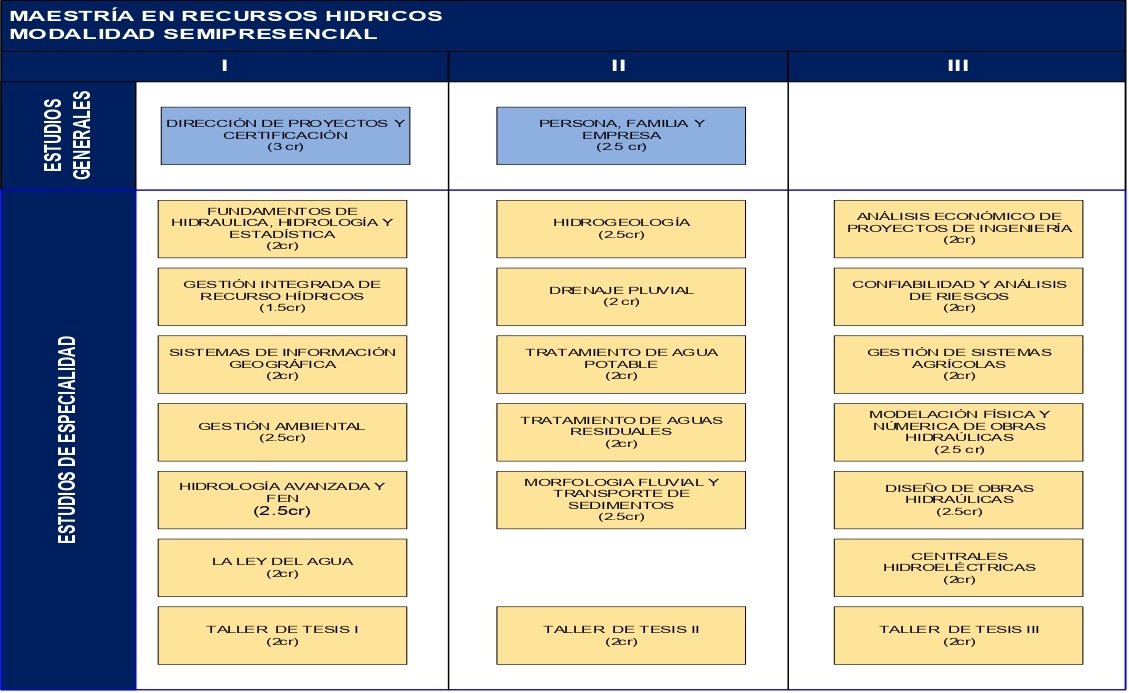
Detailed Study Plan
| Cycle | Subject Name |
| Yo |
|
| II |
|
| III |
|
Course summaries
First semester (18.5 credits)
It is a subject of a theoretical-practical nature. The main objective of the subject is to handle the basic equations of hydraulics—with emphasis on their application to the design of structures—, introduce the behavior of sediments—especially in the processes of erosion and sedimentation in channels—, provide knowledge of Basic Hydrology applied to Civil Engineering—which will allow for a proper approach to the Advanced Hydrology course—, and introduce the handling of Statistics and Probability for their subsequent application in probabilistic models in the Advanced Hydrology course.
The summary of contents is based on the physical properties of water and air, static and dynamic forces, geometric parameters of channel sections, types of flow (uniform, gradually varied, rapidly varied), channel design (Manning's formula, maximum hydraulic efficiency, minimum infiltration, channel design taking into account erosion and sedimentation), introduction: water and health, ancestral hydraulic tradition, objectives, aspects covered, evolution of the study of water resources, hydrological cycle and distribution of water on Earth, elements of climatology (atmospheric circulation, solar radiation, pressure, temperature, humidity and winds, evaporation and evapotranspiration), definitions and calculation methods, probabilities (introduction, definitions, types, theorems), statistics (definition, types), descriptive statistics and measures, probability function, and probabilistic models (definition, fitting, goodness-of-fit tests).
It is a subject of a theoretical-practical nature. Its main objective is to identify the variables of importance in the development of proposals for integrated watershed management and to apply the WEAP management model for the analysis of alternative solutions in the area of water resource management.
The summary of the contents is based on the distribution of water on the planet, integrated water resources management, the WEAP model, and the application of WEAP.
It is a practical subject. The main objective of the subject is to learn how to use the different tools and data available online and offline so that the student can place their own data in a geographical context, in order to locate, analyze and make decisions in a given project.
The summary of contents is based on the introduction to QGIS, the river basin, delimitation of a set of basins, delimitation of a basin based on a discharge point, geomorphological parameters of a basin, theory of geomorphological parameters, calculation of geomorphological parameters.
It is a subject of a theoretical-practical nature. Its main objective is to understand the knowledge areas of Project Management, execute the main processes according to the knowledge areas and the project life cycle, evaluate and select methodological tools within the body of knowledge of general project theory and the process groups for project planning and management, and introduce the project management competency model established by the International Project Management Association (IPMA).
The summary of contents is based on the project framework, project initiation, project planning/schedule, costs, quality, risks and project team, project execution/control, project closure, introduction to the concept of competencies, the value of attitude, presentation of the domains, the key competency indicators (CCIs), the key performance indicators (KPIs), the 10 people competencies and the 5 perspective competencies.
This is a course of a theoretical and practical nature. The main objective of the course is to enable students to conduct studies on water pollution and participate in establishing environmental baselines for water and air components as part of the environmental impact assessments required for new projects.
The summary of contents is based on environmental management, management instruments, ISO 14001 (environmental impact, environmental indicators and indices, characteristics, disadvantages, classification and uses, water quality indices, environmental pollution, methods of identifying impacts, components of the EIA, impacts on road infrastructure, checklists, verification lists, environmental impact, qualitative and quantitative assessment methods, and environmental management plan.
It is a subject of a theoretical-practical nature. The main objective of the subject is to enable the student to evaluate the main processes of the hydrological cycle, characterize basins and sub-basins as elements of hydrological analysis, carry out probabilistic studies of hydrological data series, inferring properties associated with different hydrological events, prepare the water balance of a basin, quantify the water resources available in a system, and determine the design flows for the protection of river basins and urban basins.
The summary of the contents is based on data acquisition and processing, the El Niño phenomenon, water resource assessment, water balance, maximum flow, runoff in rivers and reservoirs.
It is a subject of a theoretical-practical nature. The main objective of the subject is to enable students to incorporate regulatory and technical aspects into the development and implementation of hydraulic projects, and to actively participate in the working groups of the Basin Water Resources Councils and other institutions involved in Integrated Water Resources Management.
The summary of the contents is based on integrated water resources management in river basins, water resources management in Peru, water and the political constitution of Peru, national policy and strategy on water resources in Peru, the Water Resources Law, the Regulations of the Water Resources Law, water use rights and authorization for the reuse of treated wastewater, IWRM in transboundary basins, institutional framework in the integrated management of water resources, the Basin Water Resources Councils, the National Water Resources Management Plan, the Basin Water Resources Management Plan, the Water Availability Utilization Plan, hydrological ecosystem services – contributions to water resources management and social conflicts over water resources.
This course combines theory and practice. Its main objective is to learn basic research terminology and understand the prevailing epistemic paradigms of research in administrative sciences. Students will also learn to identify, analyze, and formulate a research problem relevant to the field of Water Resources, considering the basic structural aspects and norms for a research work plan.
The summary of the contents is based on the presentation of the subject, the principles of science, title and background of the research, theoretical bases, foundation, research methodology, research results, style regulations and ethical aspects.
Second semester (14.5 credits)
This is a subject of a theoretical-practical nature. The main objective of the subject is for the student to be able to identify the rocks most likely to contain water, understand the mechanisms and parameters that govern water flow in the subsurface, understand the interactions between aquifers and surface ecosystems, know the main methods of groundwater exploration and extraction, know the most salient aspects related to groundwater quality with a view to possible uses, and understand the rudiments of computer modeling of groundwater.
The summary of contents is based on hydrogeology, water in rocks, hydrogeological profiles and maps, hydraulics of water intakes, principles of hydrochemistry, water pollution, hydrogeological prospecting, legal regulations, monitoring of water levels, hydrogeological characterization and hydrogeological model.
It is a subject of a theoretical-practical nature. The main objective of the subject is to address the problem of urban drainage in the context of urbanization and modern cities, characterize rainfall in urban areas, and provide methods and tools to estimate runoff flows—both quantitative and qualitative aspects—and propose elements for the analysis and planning of urban drainage systems in cities.
The summary of contents is based on cities and drainage, urban hydrology, urban drainage planning, stormwater system design, and urban drainage models.
It is a subject of a theoretical-practical nature. The main objective of the subject is to provide anthropological and humanistic knowledge so that participants have the foundation – both on a personal level and in the workplace – for appropriate decision-making in the processes of governance and management of people, with the possibility of integrating their family into their professional development.
The summary of the contents is based on anthropological foundations of people management, anthropological foundations of ethics in professional work, the personnel function in organizations, personnel admission and training processes, personnel evaluation processes and remuneration system, talent retention in organizations, the family as the core of human and social development, the agents of work-family reconciliation, the family perspective and the gender equity perspective in companies.
It is a subject of a theoretical-practical nature. The main objective of the subject is to identify the different types of water pollutants and the applicable quality standards, and to distinguish the different types of water treatment plants according to their processes and technology.
The summary of contents is based on the drinking water treatment plant, the types of water contaminants, water quality standards (EQS), WHO quality guidelines and national drinking water standard, DS-031-2010-SA Regulation of water quality for human consumption, processes and unit operations that are applied in a PTAP, types of rapid filtration plants according to processes and technology, coagulation theory (rapid mixing and flocculation), sedimentation theory, filtration theory and disinfection theory.
It is a subject of a theoretical-practical nature. The main objective of the subject is to acquire basic knowledge in the pollution and treatment of wastewater, to appropriately use the principles and laws that govern the unit operations and processes in wastewater treatment, and to have a critical awareness of the problem of wastewater treatment.
The summary of contents is based on the hydrological cycle, the current problems of the National Sanitation System, wastewater, types of wastewater, design population, design loads, design flows, current regulations for treated effluents, unit operations (screens, grit chambers, primary sedimentation), sizing examples, conventional activated sludge technology, mechanically aerated lagoons – sedimentation lagoons, stabilization lagoons (anaerobic lagoons, facultative lagoons), treatment with aerobic biological filters, anaerobic reactors and processes, on-site wastewater treatment for small communities, septic tanks, Imhoff tanks and wetlands.
It is a subject of a theoretical-practical nature. The main objective of the subject is to acquire general knowledge about the problems of regulating riverbeds with a focus on riverbank protection.
The summary of contents is based on hydraulic equations and design, maximum hydraulic efficiency, minimum infiltration, energy equation, continuity equation, design of hydraulic structures, channels, ditches: concrete and earth, bridges, culverts, stilling basin, reservoir, sheet pile, groynes, design of riverbank defenses, general erosion, riprap, concrete slabs, concrete cable, armor, sediments (carrying and suspension), fluvial morphology of the Piura River, hydrosuction, physical modeling and numerical modeling.
It is a subject of a theoretical-practical nature. The main objective of the subject is to organize the structure and timeline for developing the research work plan and to establish the theoretical foundations of the research work following the principles of the scientific method.
The summary of the contents is based on scientific research and its stages of planning, execution and evaluation; it addresses everything related to the thesis plan or research work (it explains the criteria for its preparation, title, justification, background, objective, methodology, scheme, bibliographic references, schedule of activities and financing).
Third semester (15 credits)
It is a subject of a theoretical-practical nature. The main objective of the subject is to facilitate the economic-financial analysis of future investment projects and the learning of more advanced economic courses, as a complement to the comprehensive professional training of the Master's Degree in Water Resources.
The summary of the contents is based on the formulation and execution of investment projects, financial mathematics, project classification, criteria for evaluating projects, economic analysis of projects in the public sector, principles of costs and finance, hydroelectric concessions and Project Finance.
This is a course of a theoretical-practical nature. The main objective of the course is to introduce students to reliability theory, covering the fundamental concepts for evaluating the reliability of systems, especially those related to civil engineering, as well as relating reliability to accepted design standards.
The summary of contents is based on introductory concepts and applications, probabilistic design, risk analysis, and risk assessment.
It is a subject of a theoretical-practical nature. The main objective of the subject is to provide students with knowledge of irrigation engineering and facilitate the understanding of the main concepts of the water-soil-plant relationship, as factors for production, and knowledge of irrigation techniques in water management in the agricultural sector.
The summary of the contents is based on elements of the soil-water-plant-atmosphere system, water requirements of agricultural crops, conventional surface irrigation systems, localized pressurized irrigation systems, irrigation technologies in the face of global climate change, challenges of agricultural production systems in relation to territorial sustainability, applications of the Internet of Things (IoT) and Big Data Management (BDM) to technological activities of design and programmed operation of irrigation equipment in agricultural companies, water governance in Peru and alternative ventures in irrigation technologies.
It is a subject of a theoretical-practical nature. The main objective of the subject is to facilitate the selection of a physical or numerical model according to the particular application, to show the current capabilities (state of the art) of numerical modeling in hydraulics, as well as future trends, and to teach the use of a numerical model for practical application.
The summary of the contents is based on the future of hydraulic projects in Peru and the importance of modeling; hydraulic, physical and numerical modeling; desilting basins; riverbank protection; the design of riverbank defenses (earth dikes, riprap and groynes), using numerical models; erosion; concepts of general erosion and local erosion; bridges; bridge hydraulics and optimization of bridges with embankments; physical and numerical modeling of erosion on piers and riprap protection; intakes and dams; flow in lateral intakes and 2D modeling; sediments and the Bulle effect; and 3D modeling of intakes: flow and particles.
It is a subject of a theoretical and practical nature. The main objective is to enable students to design structures for water resource utilization and flood control.
The summary of contents is based on desanders, fall velocity, dimensional analysis, culverts, reservoir cleaning system (sediment hydrosuction), analysis of the hydraulic behavior of concrete, rapids, siphons, determination of the marginal strip and tsunamis.
This is a course of a theoretical and practical nature. The main objective of the course is to provide the concepts related to the energy analysis of hydroelectric power plants and their main components, to acquire the basic criteria for the analysis of hydropower potential, and to learn about the main technologies related to energy production using non-conventional resources.
The summary of contents is based on the introduction, power plants, definition and classification of hydroelectric power plants, elements of hydroelectric power plants, civil works, elements of hydroelectric power plants and electro-mechanical equipment.
It is a practical course. The main objective is to further the student's training and to develop a research project that meets the requirements established by the university for Master's degrees in Engineering, on a relevant topic related to water resources, organizing the structure and timeline for the research project.
The summary of the contents is based on the development of the research work to achieve the master's degree, the contextual framework, theoretical framework, methodology, results, analysis and discussion of results, conclusions and recommendations.