
Curriculum
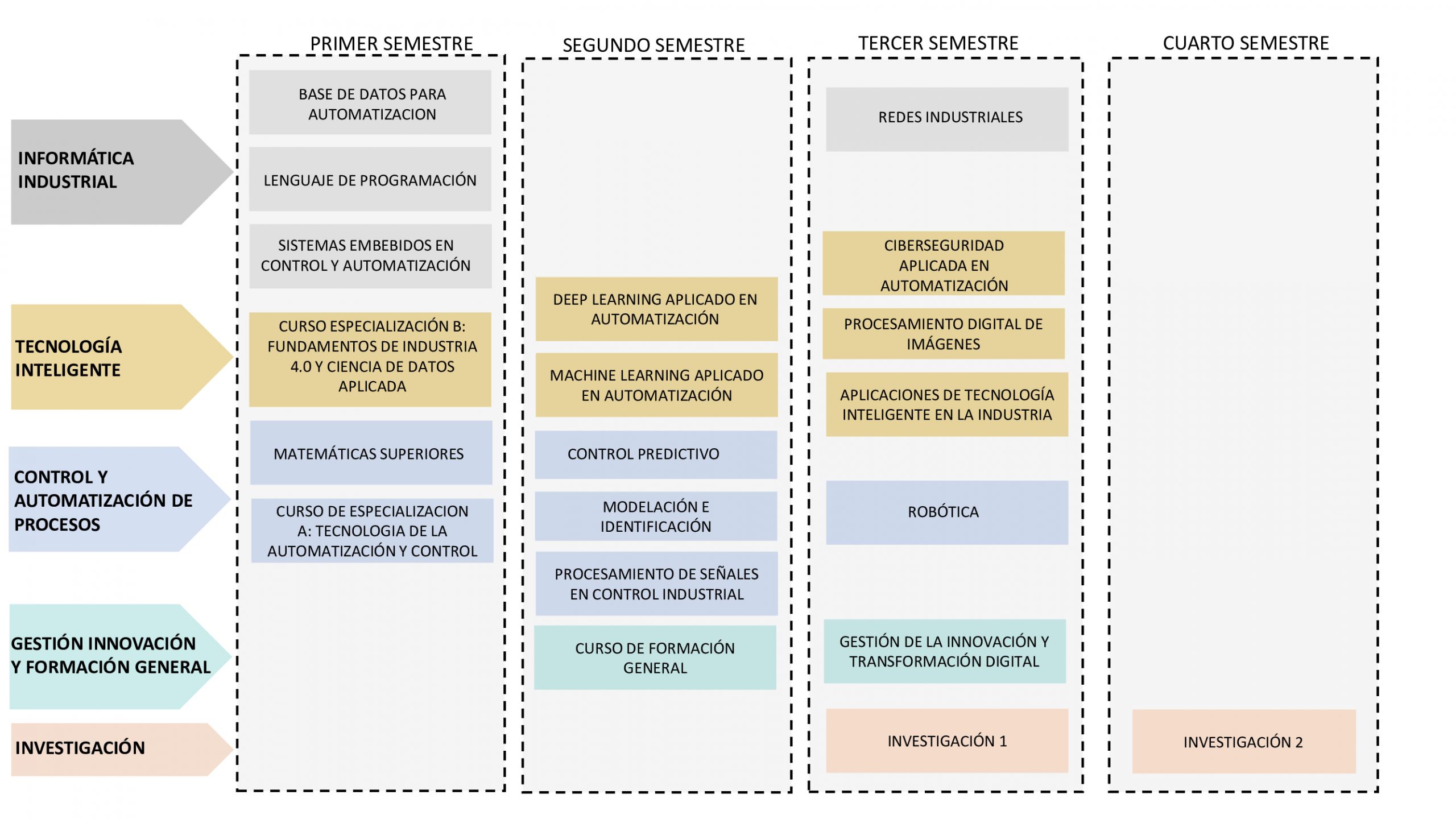
The Master's program in automation engineering with AI has 48 specific and specialized credits:
Detailed Study Plan
| Cycle | Subject Name |
| Yo |
|
| II |
|
| III |
|
| IV |
|
Course summaries
Semester I (15 credits)
This course, which combines theory and practice, will be offered in a blended format, both in person and online. The learning outcomes aim to equip students with the skills to use software tools to create algorithms, debug them, and implement predictive models for analysis. The focus is on developing efficient solutions and preparing students for more advanced applications in data science and artificial intelligence.
The content covers: programming fundamentals using Python, C++ and natural language; control structures (conditionals and loops), data types, functions, object-oriented programming, file handling and modules.
This course, which combines theory and practice, will be offered in a blended format, both in person and online. The learning outcomes aim to equip students with the ability to master key concepts in linear algebra, Laplace transforms, Fourier transforms, optimization, and statistics.
The content covers: Discrete and Continuous Systems. Frequency Analysis. Time Series. Laplace and Fourier Transforms. Gradient of a scalar field, state variables, linear algebra. Basic optimization methods, probability, variance, stationary random process, correlation.
This course, which combines theory and practice, will be delivered both in person and online. The learning outcomes are for students to understand the basic concepts of embedded systems, as well as the tools and criteria for programming them.
The content covers: Raspberry Pi, Arduino, FPGA, Hardware Description Language -VHDL-, Place & Route, and bitmap generation.
The Database for Automation course is theoretical and practical in nature and will be taught both in person and online. The learning outcomes provide participants with a comprehensive overview of different types of relational and non-relational databases capable of handling large amounts of data. Furthermore, given that projects are becoming more numerous, complex, and varied, the relevance of the content will enable graduates to manage, generate, and/or use databases to solve engineering problems. The course balances database systems theory with practical modeling and querying exercises applied to real-world scenarios.
The course covers: fundamentals of database design, implementation, and management; data models—especially the relational model; schema design using normalization; query languages such as SQL; and distributed databases and NoSQL systems.
This course, which combines theory and practice, will be delivered both in person and online. The learning outcomes aim to equip students with the skills to use process control and automation tools.
The course covers: PLC programming, remote sensors, open-loop and closed-loop systems, and PID control in industry.
The subject of Specialty Course B is theoretical-practical in nature and will be taught in person and virtually.
The course covers: basic concepts of Industry 4.0 and applied Data Science; definitions of IoT (Industrial Internet of Things) technologies, Artificial Intelligence, Cyber-Physical Systems (CPS), Big Data, Cloud Computing, and Robotics; and an introduction to neural networks.
Semester II (14 credits)
This course, which combines theory and practice, will be delivered both in person and online. The learning outcomes aim to equip students with the ability to understand the theoretical foundations of signals and their real-time processing.
The course covers: signal processing algorithms; analog and digital signals; Fourier transforms applied to signals, Hilbert transforms, and Z-transforms of signals; filtering techniques: IIR, FIR, and special filters; random signals; and power spectrum estimation.
The Predictive Control course is theoretical and practical in nature and will be taught both in person and online. The learning outcomes are for students to understand the basic concepts of different predictive controllers and to be able to apply these techniques in academic and industrial contexts.
The course content focuses on: basic characteristics of a predictive controller; minimum variance controller, Diophantine equation, prediction horizon; GPC (Generalized Predictive Control); MPC-State Variables; and MPC for multivariable processes..
The Identification course is theoretical and practical in nature and will be taught both in person and online. The learning outcomes are that the student will be able to develop simulators for predictions.
The course covers: Data-driven models. Experimentation techniques for obtaining process data. Criteria for selecting model structures. Validation metrics. Nonlinear predictive models with artificial intelligence. Algorithm simulation in Matlab and Python.
The course on machine learning applied to automation is theoretical and practical in nature and will be taught both in person and online. The learning outcomes are that students will be able to understand and develop predictive models based on machine learning techniques.
The course covers: Data preparation techniques. Validation strategies. Linear and logistic regression, support vector machines (SVM), decision trees, assembly methods (bagging and boosting), clustering (k-means), and dimensionality reduction (PCA). Assembly methods: bagging and boosting, clustering (k-means). Multilayer perceptron. Reinforcement learning with dynamic programming.
The General Education Course is theoretical and practical in nature and will be taught both in person and online. The learning outcomes are that the student will be able to assimilate knowledge of people management in innovation.
The course covers: Topics in Philosophical Anthropology. The motives for human action. Command over an individual and a group. Authority, power, and leadership in the process of digital transformation. Evaluation of managerial decisions. Ethics and Management. Agile methodologies for prototyping, focusing on design and development. Work-life balance.
The course is theoretical and practical in nature and will be taught both in person and online. The learning outcomes aim to ensure that students understand the fundamentals of Deep Learning and apply them in automation contexts.
The course content focuses on the study of convolutional neural networks, recurrent networks, regularization for deep learning, transformers for advanced applications, diffusion models, reinforcement learning, reinforcement learning with neural networks, loss functions, and activation functions.
Semester III (15 credits)
The Innovation Management and Digital Transformation course is theoretical and practical in nature and will be taught both in person and virtually, using the Virtual Platform. The learning outcomes aim to prepare students to lead innovation projects, understand the implications of digital transformation on processes from a general perspective, and develop management skills encompassing strategy, people leadership, and practical execution.
The course content includes: Elements of an innovation project and its management. Digital transformation in production processes. The agile mindset leader. The University-Business relationship in innovation processes and the Peruvian framework as support for business and industry. B2C, B2B, and Industry 4.0 trends.
The Industrial Networks course is theoretical and practical in nature and will be taught both in person and online. The learning outcomes are for students to understand the operation of data networks, the Industrial Internet, and related technologies.
The course covers: Industrial network assessment. Industrial protocols. Fieldbuses. RS-232 and RS-485 serial communication. Profibus FMS, DP, PA, MBP. IT networks, IT/OT convergence. Industrial Ethernet: CIP, Profibus DP, Modbus TCP.
The Cybersecurity in Automation course is theoretical and practical in nature and will be taught both in person and online. The learning outcome is for students to understand techniques for protecting production systems from cyber threats.
The course covers: Cybersecurity in networks. Threats. Vulnerabilities (CVE, micro HTTP). Purdue Model. Framework Standards in Cybersecurity. Implementation Groups. Controls for information security.
The Digital Image Processing course is theoretical and practical in nature and will be taught both in person and online. The learning outcomes provide participants with a comprehensive overview of the various fundamental elements of image processing.
The course covers: Two-dimensional digital imaging, 2D image acquisition, lighting, pattern classification systems, pseudocolor image processing, color image processing, Morphological Image Processing, and basic operations. Image representation in the spatial and frequency domains, filtering, segmentation, compression, and basic pattern recognition. RGB images. Multispectral, hyperspectral, and thermal images.
The Robotics course is theoretical and practical in nature and will be taught both in person and online. The expected learning outcomes at the end of the course are that the master's candidate will be able to design, transfer, and integrate robotic technology into industrial processes and, furthermore, have knowledge of the integration of other technologies, such as artificial intelligence, to enhance robotics applications.
The course covers: Fundamentals of Modern Robotics. Industrial Robotics 4.0. Service Robotics. Artificial Intelligence in Modern Robotics. Global and Local Perspectives on Robotics.
The Research 1 course is theoretical and practical in nature and will be taught both in person and online. The expected learning outcomes at the end of the course are that the student will develop a thesis plan for their research project and present it to the master's program director.
The course covers: Description of the phases of a research project (state of the art, methodology, development plan, conclusions). Use of databases. Bibliographic reference guidelines. Development of a research project leading to a master's thesis, including objectives, justification, and preparation of the state of the art, under the guidance of an advisor.
The course "Applications of Smart Technology in Industry" is theoretical and practical in nature and will be taught both in person and online. The learning outcome is for students to understand how to implement a technological project using smart technology.
The course covers: practical cases with results illustrating performance evaluation metrics.
Semester IV (4 credits)
The Research 2 course is theoretical and practical in nature and will be taught both in person and online. The expected outcome is the submission of a complete thesis to the Faculty of Engineering.
The content of the subject is the development of the methodology, experimentation and conclusions of the research work.