- Inicio
- Human medicine
- medical education
- Human medicine
- medical education
- Development, incorporation and evaluation of learning evaluation strategies in the undergraduate degree in Human Medicine.
- Conceptualization of professionalism and methodologies for its acquisition in undergraduate students of Human Medicine.
- Curriculum development by objectives and competencies of the Human Medicine undergraduate curriculum.
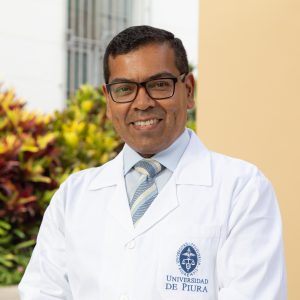 |
César Gutiérrez Villafuerte cesar.gutierrez@udep.edu.pe Faculty of Human Medicine |
Master in Epidemiology and Surgeon from the Universidad Nacional Mayor de San Marcos. PhD student in Humanities with a mention in cultural studies at the University of Piura. Associate Academician of the National Academy of Medicine. Professor of the Department of Preventive Medicine and Public Health of the Universidad Nacional Mayor de San Marcos (UNMSM).
In postgraduate studies he has taught in Master's programs in Medicine, Epidemiology, Public Health and Biostatistics at various national universities. He was Director of Research and Information Management of the Complementary Medicine Management of EsSalud. |
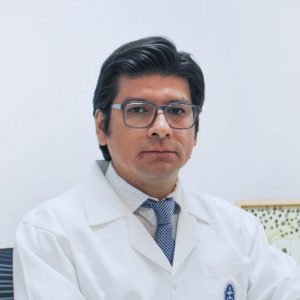 |
Romani Franc Romani franco.romani@udep.edu.pe Faculty of Human Medicine |
A medical doctor and surgeon with a Master's degree in Epidemiology from the National University of San Marcos and a Master's degree in Biomedical Engineering from the Pontifical Catholic University of Peru. He holds a diploma in Science Communication. He is a professor at the Faculty of Human Medicine of the University of Piura. He has served as Executive Director of the Office of Technology Transfer and Training, and of the Executive Office of Research at the National Institute of Health. He has also served as President of the Research Committee of the National Institute of Health. From 2018 to 2021, he was the scientific editor of the Peruvian Journal of Experimental Medicine and Public Health. He has numerous scientific publications in national and international journals in the fields of public health, epidemiology, and training of human resources in health research. |
| Project | Year | Project status | Description |
|---|---|---|---|
| Comparison of scores obtained in two progress test modalities applied to human medical students | 2026 | Completed | The Faculty of Human Medicine at the University of Piura administers the Annual Medical Examination. This assessment provides an opportunity to analyze its results and determine whether the curriculum generates incremental changes in student performance as they progress through their university studies. This trend will be measurable through adjustments to the design of our progress test. |
| Trends in medical student progress testing: a multi-measurement study from 2017 to 2024 | 2025 | Completed | The Faculty of Human Medicine at the University of Piura implements the Annual Medical Examination. This assessment provides an opportunity to analyze its results and determine whether the curriculum generates incremental changes in students' academic performance as they progress through their university studies. This study will allow for the identification of performance patterns among medical students, patterns that could be studied as predictors of other outcomes, such as performance on the National Medical Examination or the Medical Residency Examination. |
| Performance on progress tests (Annual Medical Examination) as predictors of performance on the National Medical Examination | 2025 | Completed | This study seeks to determine whether the results of the University of Piura's Faculty of Medicine's Annual Medical Examination are a predictor of performance on the Annual Medical Examination. If this finding is confirmed, the Annual Medical Examination results could serve as an early indicator to identify students who require additional learning support or specific preparation for the Annual Medical Examination. Our findings could serve as a reference for other universities to implement progress tests that allow for early prediction of their students' performance on future licensing exams and address learning gaps among those who perform poorly on progress tests. |
| Effect of a curricular educational intervention on scientific literacy skills in human medical students at a university in Lima, Peru | 2024 | Completed | This research will evaluate whether the adapted CREATE intervention improves scientific literacy skills among first-year medical students. The results will allow for the initiation of a line of research to assess the effect of this intervention in other university contexts, as well as in other health science programs. This intervention is characterized by being delivered during a course (curricular strategy) and being based on the CREATE method (Consider, Read, Elucidate hypotheses, Analyze and interpret data, Think of the next Experiment). This intervention also improves critical thinking and content integration skills, and enhances students' understanding of what science does, how it does it, and why. |
| Progression in the proportion of correct answers on a Progress Test among first- to sixth-year human medical students: Secondary analysis of the results of the annual medical examination based on clinical cases. | 2023 | Completed | The present exploratory study will allow us to analyze how the progression occurs in the number of correct answers to the questions of a summative evaluation throughout the different years of study. This analysis will allow us to evaluate, for the first time, the results of the knowledge acquired in basic science courses by students since the beginning of activities at the medical school in 2017. |
| Cultural adaptation of an instrument for measuring scientific literacy in Peruvian university students of human medicine | 2023 | Completed | This study was designed to adapt an instrument measuring scientific literacy in medical students from English to Peruvian Spanish. Scientific literacy is the set of skills for engaging with science-related topics and developing reasoned discourse about science and technology. These skills are fundamental for beginning medical studies; therefore, having a valid and reliable instrument will allow for diagnosing these abilities at the start of the program or can be used as a monitoring tool throughout the course. |
| Experience, attitudes and perceptions towards scientific research in students of the Faculty of Human Medicine of the University of Piura in the context of a model for training competencies for research based on curricular design | 2022 | Completed | This study sought to preliminarily measure the changes of medical students regarding how they perceive and have experienced scientific research during their years of study at the Faculty of Medicine of the University of Piura. These results will allow us to make adjustments to our curricular model for training research skills. |
Factors associated with scientific literacy in medical students at a university in Peru
Available in Medical Education Research
Trend in retention of basic science knowledge in a progress test among medical students
Available in Medical Education
Cultural adaptation to Peruvian Spanish and psychometric validation of an instrument to measure scientific literacy in medical students
Available in the Annals of the Faculty of Medicine of San Fernando
Psychometric properties of medical students' attitude questionnaires towards research and scientific reading
Available in the Anales Magazine of the Faculty of Medicine
Perceptions of scientific literature and reading of original articles in medical students
Available in the Journal of Research in Medical Education
Experience, attitudes and perceptions towards scientific research in medical students in the context of a curricular strategy for training research skills
Available in Medical Education Magazine
Correlation between a written summative evaluation and the weighted average in human medicine students
Available in the Journal of Research in Medical Education
Training by competencies in scientific research based on curricular design in a faculty of human medicine
Available in the Anales Magazine of the Faculty of Medicine
 EN
EN  ES
ES