
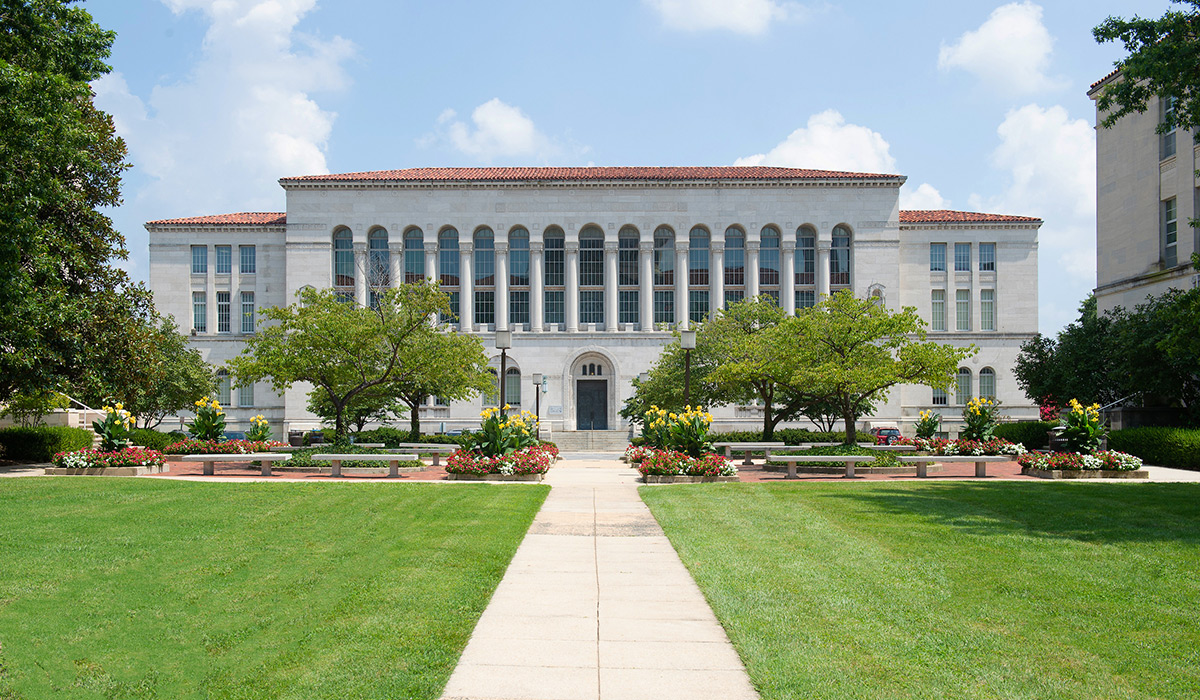
The Catholic University of America

Benefits of the agreement
Recently, the University of Piura (UDEP) has established an agreement with the Catholic University of America (CUA). This agreement allows UDEP students who have successfully completed all required courses up to the fifth cycle in the Academic Program of Economics, transfer to CUA to complete your studies.
At the Catholic University of America, students have the option of obtaining degrees in Bachelor of Sciences in Economics o Bachelor of Sciences in International Economics and Finance.
- The agreement allows UDEP students with good academic performance to have a 50% scholarship in CUA.
- You can take courses ahead of schedule Master in Applied Economics in CUA and obtain the degree in less than 1 additional year.
- You can perform the Optional Practical Training, anywhere in the USA, up to 3 years after you have finished your studies.
Application requirements
- Have completed successfully the courses of the Curriculum of the Academic Program in Economics up to the fifth cycle.
- Index accumulated equal to or greater than 12.5 at the time of application.
- Present a letter of recommendation issued by at least one professor from the University of Piura.
- Proof of knowledge from English: TOEFL above 80, IELTS greater than 6.5.
- Not having no serious disciplinary sanction during his studies at UDEP.
- Have no outstanding debts with UDEP.
Application Process
- Send an email to the Director of the Academic Program in Economics at UDEP to request certification that you meet the established requirements.
- Applications to transfer to CUA are submitted through their official website. Access it via the following link: Online application to CUA.
- Required documents:
- Official transcript of grades from UDEP, translated into English, including all courses from the 1st to the 5th semester.
- Letter of recommendation in English, issued by at least one professor from UDEP.
- Proof of English language proficiency. See requirements at: English proficiency requirements for international students at CUA.
- Once you have completed the online application, inform the Economics Program at UDEP.
- The Catholic University of America will review your application. If accepted, you will receive an admission letter detailing the registration process, visa application information, and other relevant details.
- Once you obtain the corresponding visa, you will be able to enroll at CUA and begin your studies at this university.
Frequently Asked Questions
Students transferring from UDEP can begin classes at CUA at two different times during the year. For the 2023-2024 academic year, the schedule for the start of classes was as follows:
- Fall Semester: August 28
- Spring Semester: January 8th
It is recommended to start the process six months before the start of classes at CUA.
Pass the courses from cycles I to V, and have a cumulative index of at least 12.5.
The agreement allows UDEP students with good academic standing to receive a 50% scholarship for studies at CUA. With this, the annual cost (2 semesters) at CUA for the 2024-2025 period is US$27,635. More information at: https://enrollment-services.catholic.edu/costs/tuition-fees/2024-2025undergraduate.html
This agreement allows your Economics studies at UDEP to be validated as years of study at CUA. To transfer, you must take the courses corresponding to the 1st, 2nd, 3rd, 4th, and 5th semesters of the 2020 curriculum for the Economics Program at UDEP.
Yes. But you must still meet all the required criteria. Please note that upon becoming a UDEP alumnus, you will no longer be a Pronabec scholarship recipient. Furthermore, you should consult with Pronabec regarding the implications of transferring to a foreign university.
No. This agreement is exclusively for regular UDEP students.
Once you are admitted to CUA, the university will guide you through the process of obtaining your student visa from the US Embassy.
Economics at CUA is classified as a STEM major, so you could stay and do your Optional Program Training (OPT) anywhere in the USA for up to three years after completing your studies.
An international baccalaureate is not required to access the agreement.
With your fifth-semester enrollment document and official transcript up to the fourth semester, you can begin the CUA application process. Upon successful completion of the fifth semester, you must update your transcript up to the fifth semester of studies..
After the fifth semester at UDEP and thanks to the agreement with CUA, you will have 3 or 4 semesters left to obtain your diploma at CUA.
There is a difference between living on campus and living off campus. You can check the following links for information on associated costs such as housing, food, books, etc.
https://financial-aid.catholic.edu/costs/undergraduate-costs.html
Yes. But you must also meet all the requested requirements.
No. If you have successfully completed the courses corresponding to the 1st, 2nd, 3rd, 4th and 5th year of the curriculum of the Economics Program at UDEP, you can apply.
As long as you are a UDEP student, have successfully completed the courses of the 1st, 2nd, 3rd, 4th and 5th cycle of the curriculum of the Economics Program and have met the stated requirements, you can apply.
Students who transfer are expected to successfully complete their degree at CUA. After transferring to CUA, you will have the status of a UDEP alumnus. If, due to an emergency, you must leave CUA and return to Peru to complete your studies, you may request readmission to the UDEP Economics Program.
You can choose one of the following academic degrees:
- Bachelor of Sciences in Economics
- Bachelor of Sciences in International Economics and Finance
Yes. The agreement allows you to pursue the Master in Applied Economics at CUA, which lasts one year. With good academic performance, you can even request credit for up to 40% credits from the Master's program, allowing you to complete it in less than a year after obtaining your Bachelor of Science degree. CUA will provide you with the costs.