
Benefits of the agreement
- Law students will be able to obtain a double international degree by studying an additional year at UCJC.
- UCJC has an average score of 3 out of 5, according to the QS Stars University Ratings. It received the highest possible score (5 stars) in the areas of employability and facilities, and 4 stars in internationalization and integration.
- The university offers students the opportunity to address the legal challenges posed by emerging technologies, through the Center for Legal Innovation (CIJE).
- Students will be able to participate in the International Club, where they carry out intercultural activities, organized by Fulbright teaching assistants.
Application requirements
The calls for applications will be open to UDEP students who meet the following requirements.
- Undergraduate students of the academic program of Law who are in their 10th semester and have passed the corresponding number of credits, according to their study plan.
- Students who have ability to express oneself, orally and in writing.
- Students who do not have no disciplinary sanctions or debt at the university.
The call will be made once a year, and the directors of each academic program will make the final pre-selection.
Application Process
The academic programs will conduct the internal selection among interested students who submit the following documents:
- Official academic record.
- Curriculum vitae.
- Letter of motivation to pursue your studies at Camilo José Cela University.
- Copy of valid passport.
Get to know CJC!
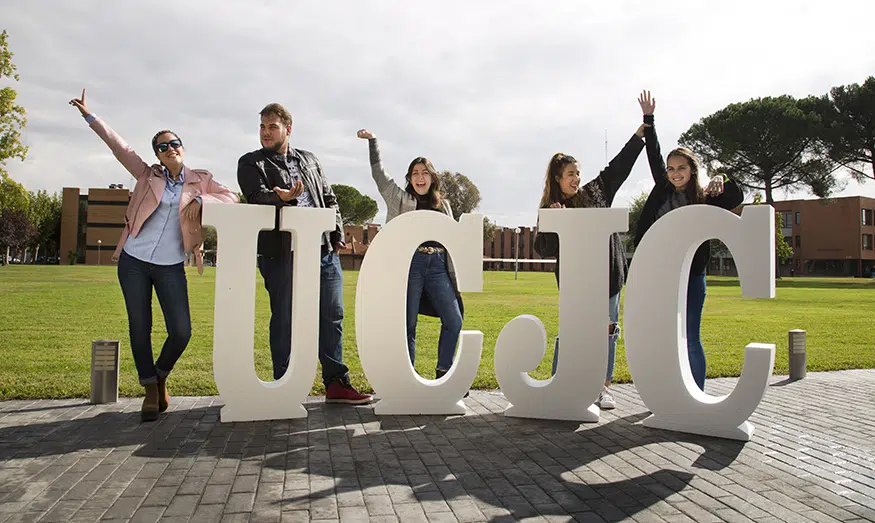
The agreement between the University of Piura and the Camilo José Cela University (UCJC) of Spain offers students of the Faculty of Law, both from the Lima and Piura campuses, the opportunity to obtain a double graduate degree from both universities.
Students must complete their final year at UDEP at Camilo José Cela University, either virtually or in person in Madrid, Spain, to obtain a law degree from UCJC.
| Program Title at UDEP | Program Title at UCJC |
| Bachelor's degree and professional title in Law (Faculty of Law) | Bachelor of Laws (Faculty of Communication and Humanities) |
Students will be able to specialize in the most in-demand and highest employability sectors in the legal field:
- ICT LawThe student will acquire knowledge about data protection, compliance, cybercrime and industrial property.
- Security LawThe student will acquire knowledge about the legal framework of public and private security, road safety, penitentiary institutions, state security forces and bodies, and international and European regulatory sources for occupational risk prevention.
UDEP students must take the following courses from the curriculum at UCJC, either virtually or in person:
FIRST YEAR | ||||
Semester | Course Name | Guy | Credits | Total |
1st | Basic principles of political science | Basic | 6 | 12 |
2nd | Basic principles of criminology | Basic | 6 | |
SECOND YEAR | ||||
Semester | Course Name | Guy | Credits | Total |
1st | Elements of constitutional law | Mandatory | 6 |
24 |
1st | Elements of EU law | Mandatory | 6 | |
2nd | Elements of Criminal Law II | Mandatory | 6 | |
2nd | Elements of Administrative Law II | Mandatory | 6 | |
THIRD YEAR | ||||
Semester | Course Name | Guy | Credits | Total |
1st | Elements of procedural law I | Mandatory | 6 | 12 |
2nd | Elements of Procedural Law II | Mandatory | 6 | |
FOURTH YEAR | ||||
Semester | Course Name | Guy | Credits | Total |
1st | Elements of intensification in the study (elective subjects) | Optional | 30 |
54 |
2nd | External Internships | External Internships | 15 | |
2nd | Final Degree Project | Final Degree Project | 9 | |
Camilo José Cela University was founded in 2000 as part of the SEK Educational Institution. As a B Corp, it leads a global movement promoting ethical values and innovation, contributing to building a more sustainable, shared, and lasting future. Furthermore, it operates under four strategic pillars: entrepreneurship and innovation, technology and digitalization, social impact, and well-being.
| Program Title at UDEP | Program Title at UCJC |
| Bachelor's degree and professional title in Law (Faculty of Law) | Bachelor of Laws (Faculty of Communication and Humanities) |
Students will be able to specialize in the most in-demand and highest employability sectors in the legal field:
- ICT LawThe student will acquire knowledge about data protection, compliance, cybercrime and industrial property.
- Security LawThe student will acquire knowledge about the legal framework of public and private security, road safety, penitentiary institutions, state security forces and bodies, and international and European regulatory sources for occupational risk prevention.
UDEP students must take the following courses from the curriculum at UCJC, either virtually or in person:
FIRST YEAR | ||||
Semester | Course Name | Guy | Credits | Total |
1st | Basic principles of political science | Basic | 6 | 12 |
2nd | Basic principles of criminology | Basic | 6 | |
SECOND YEAR | ||||
Semester | Course Name | Guy | Credits | Total |
1st | Elements of constitutional law | Mandatory | 6 |
24 |
1st | Elements of EU law | Mandatory | 6 | |
2nd | Elements of Criminal Law II | Mandatory | 6 | |
2nd | Elements of Administrative Law II | Mandatory | 6 | |
THIRD YEAR | ||||
Semester | Course Name | Guy | Credits | Total |
1st | Elements of procedural law I | Mandatory | 6 | 12 |
2nd | Elements of Procedural Law II | Mandatory | 6 | |
FOURTH YEAR | ||||
Semester | Course Name | Guy | Credits | Total |
1st | Elements of intensification in the study (elective subjects) | Optional | 30 |
54 |
2nd | External Internships | External Internships | 15 | |
2nd | Final Degree Project | Final Degree Project | 9 | |
Camilo José Cela University was founded in 2000 as part of the SEK Educational Institution. As a B Corp, it leads a global movement promoting ethical values and innovation, contributing to building a more sustainable, shared, and lasting future. Furthermore, it operates under four strategic pillars: entrepreneurship and innovation, technology and digitalization, social impact, and well-being.
Contact us
Academic Coordinator
Ana María Saavedra
Institutional Coordinator
Ana Cecilia Crisanto